 United Kingdom
 France
 Italy
Italy
 Germany
 Sweden
 Spain
Spain
 Canada
 India
India


Request a Quote
Request a Quote
Triethylene Glycol (TEG) for Gas Dehydration
Triethylene Glycol (TEG) for Gas Dehydration
Custom Content One
Natural gas from wells must be dehydrated prior to transfer or it can freeze and plug the pipeline. Triethylene Glycol (TEG) is used as a desiccant to remove the water at a dehydration plant.
In a simplified dehydration plant, wet gas enters a contact tower where lean liquid TEG is cascaded countercurrent to the gas, absorbing the water, and dry gas exits the tower. This now rich TEG flows through a reboiler where water is removed, and is then pumped back to the contact tower against natural gas line pressures
Pump requirements include high pressure (up to 1500 PSI / 102 bar), high temperature (up to 230ᵒF / 110ᵒC), low viscosity (3-8 cPs), handling abrasive particles and remote 24/7 operations. A particularly difficult challenge is thermal shock at startup, a common mode of failure for some pumps, whose internals may expand faster than the casing when hit with hot fluid. Positive displacement pumps are uniquely suited to handle the pressures, temperatures, viscosities, abrasives and duty cycle.
Custom Content One
Viking in the Process
While natural gas-driven reciprocating positive displacement pumps were used for decades, they exhausted this potent greenhouse gas and their use is now discouraged or prohibited. Multiplex reciprocating pumps are also used, but suffer high maintenance as they are not usually considered a continuous duty pump.
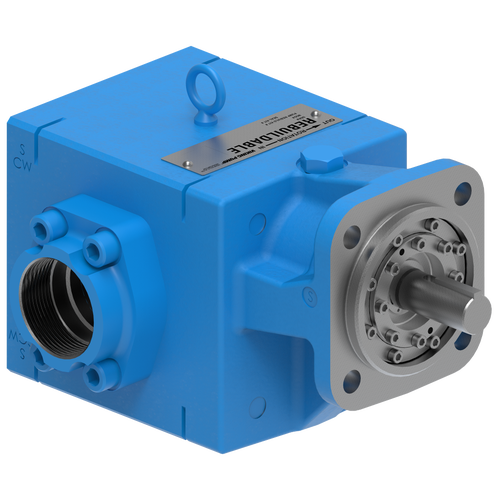
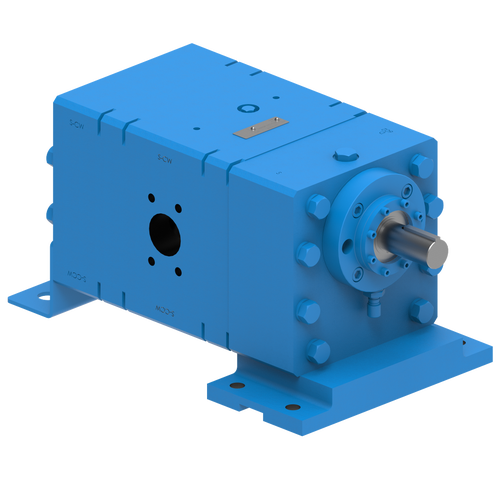
Viking motor-driven rotary positive displacement TEG pumps handle all of the pressure, temperature, viscosity, abrasive and duty cycle challenges. Significantly, they have been designed and validated to withstand up to a 225⁰ thermal differential without contact, simplifying dehydrator startup routines that otherwise would require slowly warming the pump under low pressure through a bypass. These pumps are usually duplexed with one as a standby, periodically alternating operation, using explosion-proof drives.
Custom Content Two
Applications
- New TEG transfer from storage to process
- Lean TEG transfer from reboiler to contactor
Recommended Pumps
Articles / Case Studies
A new EPA rule (Dec 2, 2023) mandates zero-emissions pumps for oil & gas ops, replacing natural gas-driven pumps. It also limits other gas-powered equipment, curbs fugitive emissions, and reduces flaring of associated gas—with few exceptions.

Viscosity is a measure of a liquid’s resistance to flow. And you don’t need to work in a laboratory to observe this. Anyone who’s spent any time in the kitchen has observed a variety of liquids with a wide variety of viscosities.
Videos

 Welcome to Viking Pump's Machine ShopThis is Viking Pump’s machine shop in Cedar Falls, Iowa. Continual investments in machines and people simplify and expedite production – enabling shipment for thousands of products every year.February 28, 2025
 Welcome to Viking Pump's FoundryThis is Viking Pump’s foundry in Cedar Falls, Iowa. For decades, the Viking Pump foundry has been a pillar of our vertical integration capabilities – allowing for the nimble production of castings and parts to satisfy customer needs and support new product development.February 14, 2025