 United Kingdom
 France
 Italy
Italy
 Germany
 Sweden
 Spain
Spain
 Canada
 India
India


Request a Quote
Request a Quote
Molten Sulfur
Molten Sulfur
Custom Content One
Sulfur is commonly a byproduct of natural gas and oil refining. It may transported and used as a solid, but when heated, molten sulfur provides advantages in transportation and industrial process applications.
Molten sulfur is difficult to pump due to the very narrow temperature range that it can be handled. It is typically solid up to 240°F, and then re-solidifies again around 370°F. The suggested handling range is 270°F - 310°F, where the viscosity is 6 to 9 cPs. It’s specific gravity of 1.8 reduces available suction lift. Due to the narrow temperature range, pumps and piping must be jacketed for steam or hot oil heating, or electrically heated.
Molten sulfur is often stored in concrete pits and pumped out by submerged, pit-mounted vertical centrifugal pumps with extended shafts and motors mounted above the pit cover. There are numerous applications where positive displacement pumps are preferred, however, particularly metering into furnaces to make SO2 or sulfuric acid, and in other low flow metering applications to add sulfur to other products.
Custom Content One
Viking in the Process
Viking pumps may be used to meter molten sulfur through nozzles into furnaces to make sulfuric acid or sulfur dioxide where a certain volume of sulfur is required per certain volume of air. These furnaces may be found at some sulfur recovery units at gas plants and refineries, at tanneries and pulp and paper mills, smelters and phosphate fertilizer plants. Viking pumps also transfer molten sulfur to wet prilling units and pastillators, and are used to meter sulfur as an ingredient in some cosmetics and skincare products.
Custom Content Two
Applications
- Molten sulfur transfer and metering
Recommended Pumps
-
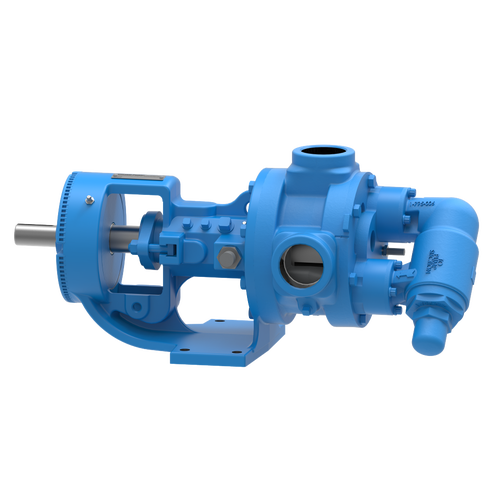
224C SERIES™
- Cast Iron
- Packing
- 15-500 gpm | 3.5-114 m3h
-
124E SERIES™
- Cast Iron
- Packing
- 320-1600 gpm | 114-364 m3h

Articles / Case Studies

Viscosity is a measure of a liquid’s resistance to flow. And you don’t need to work in a laboratory to observe this. Anyone who’s spent any time in the kitchen has observed a variety of liquids with a wide variety of viscosities.

Unlike most of my colleagues I didn’t start out with a mechanical background. While they were studying kinetics and machine design, I was studying digital electronics and industrial power. When I started my career in the world of pumps, I had to learn a whole new set of concepts. What was surprising was that while the terminology may be a bit different, the concepts are very similar. Think of the following as a “Rosetta Stone” for translating the common terms and concepts of fluid systems to your more familiar terms and concepts of electrical systems.
Videos

 Welcome to Viking Pump's Machine ShopThis is Viking Pump’s machine shop in Cedar Falls, Iowa. Continual investments in machines and people simplify and expedite production – enabling shipment for thousands of products every year.February 28, 2025
 Welcome to Viking Pump's FoundryThis is Viking Pump’s foundry in Cedar Falls, Iowa. For decades, the Viking Pump foundry has been a pillar of our vertical integration capabilities – allowing for the nimble production of castings and parts to satisfy customer needs and support new product development.February 14, 2025