Build a Career at Viking Pump

[LISA] My name is Lisa Schoborg. I'm a senior data analyst at Viking Pump and I've been here for 18 years. [CHRIS] My name is Chris Mihm. I'm the program manager with the global distribution group and I've been with Viking for just over 20 years. [Andi] My name is Andi Bicket. That's an I, not a Y. I am a senior graphic designer at Viking Pump and I have worked here for 20 years. [BRUCE] Bruce Helgeson. I'm a senior operations engineer here at Viking Pump. Been with Viking for roughly 36 years. [INTERVIEWER] Look back.

What a WATER Barometer Teaches Us About Pumps

This is a gear pump, a type of rotary positive displacement pump. Its tight-fitting clearances allow it to evacuate air in the suction line to prime the pump. And once primed, it's capable of pulling even higher vacuums. This ability to self-prime is key in applications like unloading drums, totes, rail cars, and barges. But as good as this pump is at pulling the liquid in, it's always going to be limited and not based on the pump. It's based on an invisible force pushing the liquid in from the outside, and that's atmospheric pressure.

Viking Pump: Manufactured and Assembled in Cedar Falls, Iowa

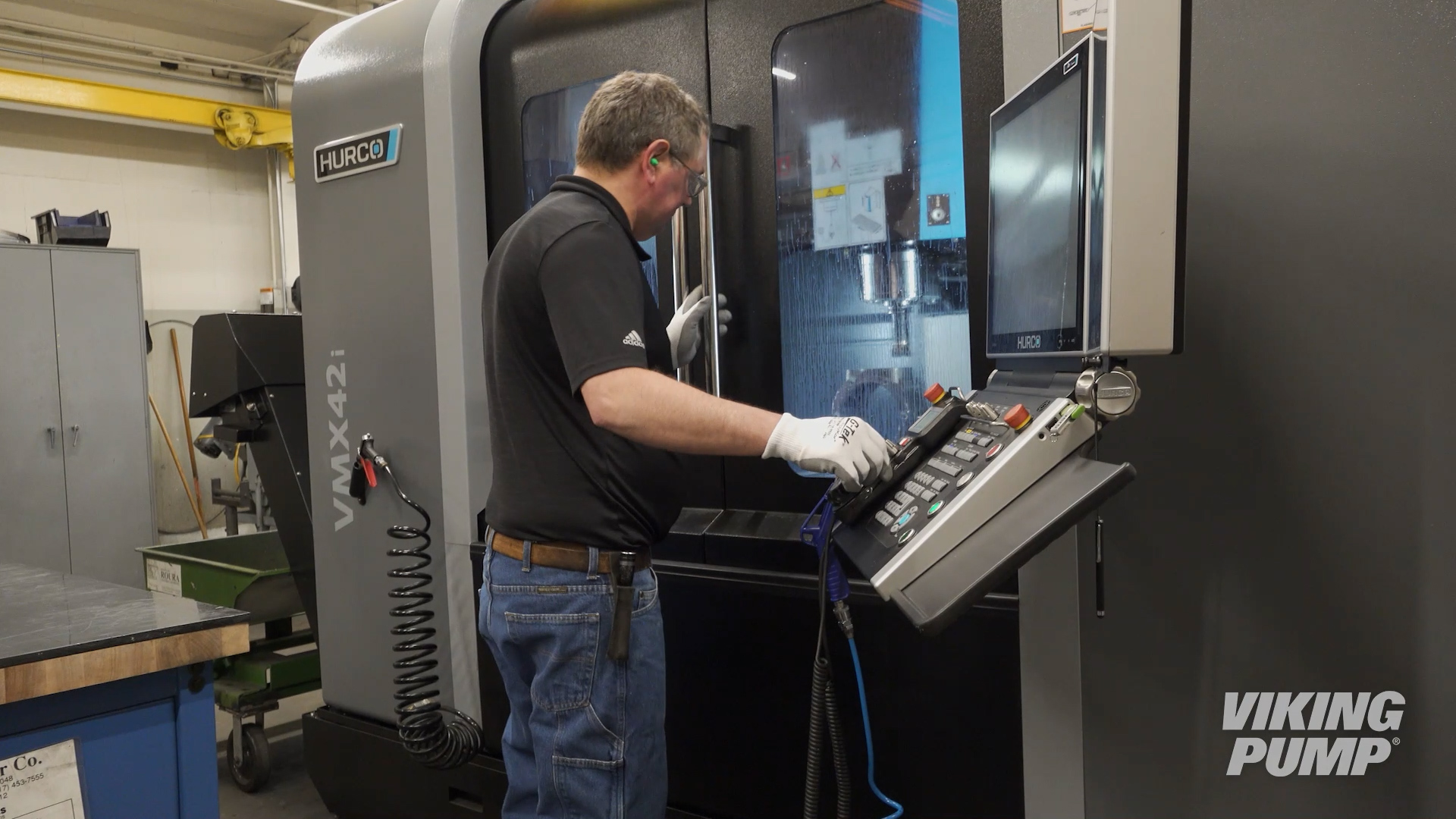
Viking Pump is the global leader in positive displacement pumping solutions and we proudly manufacture and assemble our products in Cedar Falls, Iowa. With our own dedicated foundry and machine shop, we build our products from start to finish to our own high standards. This vertical integration gives us better control of our supply lines, enhances our ability to respond to change, and creates stability for our partners and customers. We’ve been centrally located in Iowa since 1911. We're proud of that history. We're proud of the work we've done, still do, and will do together.

How mechanical seals work in pumps

Mechanical seals are extremely common in the pumping industry - and come in a wide range of materials and options. In its simplest form, a single component mechanical seal has two faces that contact and create a seal. These seal faces are lapped to a smooth, high quality finish. One face rotates with the pump shaft - while the other is held stationary in the pump housing. Once a small amount of process liquid reaches the seal faces, a hydrodynamic liquid film is created - this is what forms the seal and lubricates the faces.

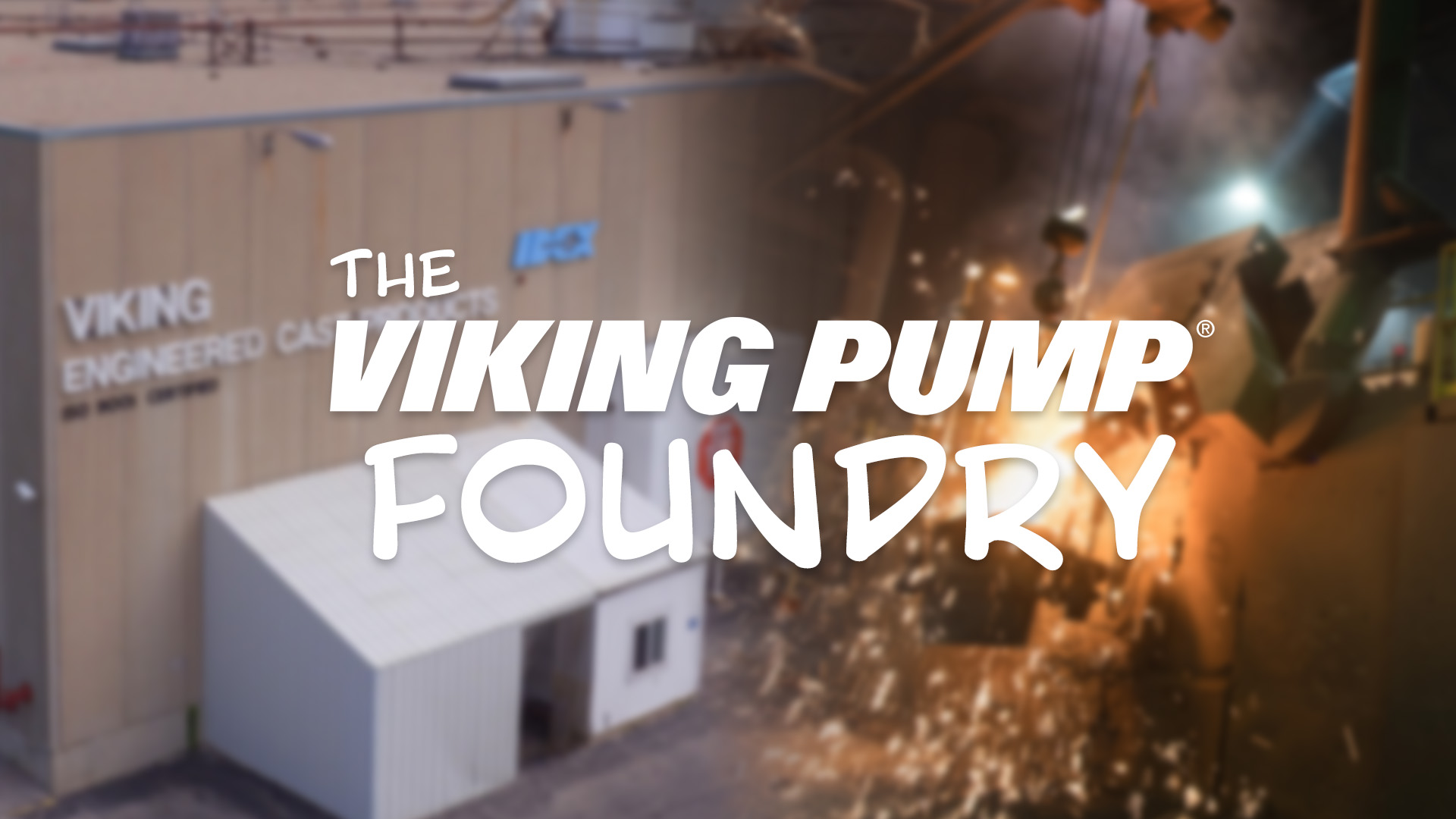
Viking Pump Foundry from the outside

Exploring Viking Pump's Foundry: A Leader in Manufacturing Gear Pumps

Search Description

Welcome to the Viking Pump foundry in Cedar Falls, Iowa, where we’ve been at the forefront of manufacturing gear pumps for decades. Our foundry is a cornerstone of our vertical integration capabilities, allowing us to produce castings and parts at speed.


50 States / 50 Pumping Applications: Iowa, Rhode Island, California, West Virginia, Colorado

Viking Pump’s original applications started at home, right here in Iowa. This original list included asphalt, fuel oil, turpentine, linseed oil, and water but did not include one of Viking Pump’s most common applications in the state today: corn syrup. Corn syrup is a sweetener made from, you guessed it…corn, and used in a variety of foods, candies, beverages, and pet foods. Next, is Rhode Island. Bunker C has many names: Heavy Fuel Oil, Bunker Oil, #6 Fuel Oil.

House of Hope is breaking cycles for good in the Cedar Valley

[NARRATOR] The Viking Pump ROOTS program is proud to partner with House of Hope in serving the Cedar Valley. [DUSKY] Female-led households in Iowa struggle for economic security more so than their married or partnered counterparts and women who age out of foster care are the highest at risk for becoming single mothers in homelessness. So if we are going to really make a generational impact, which is our goal, we want to truly break cycles for good, long-term. We have to address what's happening with single mothers and women who age out of foster care.

So your pump is making noise due to cavitation. Now what?

Join Viking Pump's Chad Wunderlich as he describes the multiple ways to address and solve for a cavitating pump. 


So just to recap: a cavitating pump is one that is exhibiting noise, loss of capacity, and if left unchecked can lead to localized pitting of the pump internals. The cause is excessive vacuum at the pump inlet. So what's the fix? 


For most systems, it starts with atmospheric pressure - but you can't move your entire facility to sea level. So what CAN you fix?

What causes pumps to cavitate? And why is my pump so LOUD?

In this Pump Report, Chad covers the causes and symptoms of positive displacement pump cavitation.


Hi, I'm Chad Wunderlich with Viking Pump. In a previous video we discussed the priming capability of positive displacement pumps, like this gear pump. This is due, in part, to the pump's ability to develop vacuum...but what happens if that vacuum gets too high? 


Today we're going to talk about cavitation. You're watching the Pump Report.