 United Kingdom
 France
 Italy
Italy
 Germany
 Sweden
 Spain
Spain
 Canada
 India
India


If you walk through Viking Pump’s museum in Cedar Falls, Iowa, you’ll find a brief acknowledgment of our company’s role in World War II. The basics are there: pumps for tanks, submarines, and surface ships. A note about machining artillery shells. But the full story — the one that lived in the pages of the Viking Vacuum, our employee newsletter at the time — is far richer than those few lines suggest.
This is a story about a pump company that went to war. Not just with its products, but with its people. More than 100 Viking Pump employees left their machines and workbenches to serve in the armed forces. The plant shifted to around-the-clock operations. And three of those employees never came home.
This Memorial Day, we’re going back to the archives to tell their story.
“All Else Is Secondary”
In early 1942, Viking Pump President George Wyth addressed the war head-on. In his annual report to stockholders, dated February 1, 1942, “This war was not of our choosing,” he wrote, “and we kept out of the maelstrom of hate and mass murder in Europe for a long time.” The attack on Pearl Harbor, he said, “left us no alternative.”
Wyth framed the fight in unmistakable terms: “America, in company with her allies, is engaged in a crusade to crush those predatory nations that are engaged in international banditry.” And he was clear about where manufacturing fit in. “This is a war of machines,” he wrote, “and is the kind of a war to which the American genius is best adapted.”
The scale of mobilization at Viking Pump was significant. In the 1942 annual report, Wyth reported that the plant was running 24 hours a day across three shifts, each working 50 hours per week. The Army had already taken 70 employees into service, a number that would grow past 100 before the war’s end.
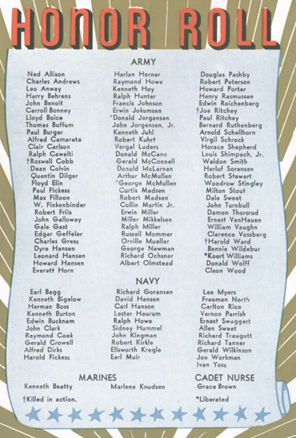
The Gold Stars
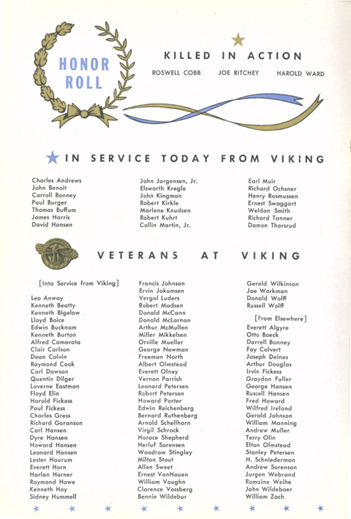
By mid-1944, the service roster had expanded to include categories no one wanted to see: Prisoners of War and Killed in Action. Before the war was over, three Viking Pump employees would give their lives.
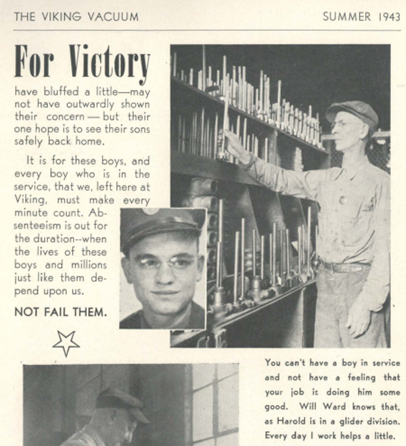
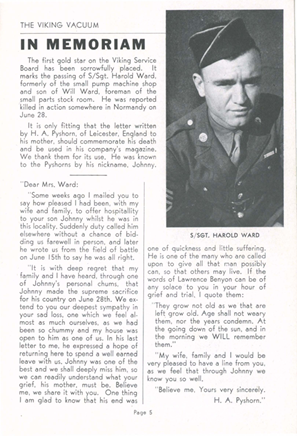
Staff Sergeant Harold John Ward had worked in the small pump machine shop before enlisting. His father, Will Ward, also worked at Viking Pump and was foreman of the small parts stock room. In the Summer 1943 issue of the Viking Vacuum, the two were photographed together as part of a feature on fathers at work and sons at war. A year later, Harold was killed in action in Normandy on June 28, 1944.
A detailed profile of his life is preserved by the NH&D Silent Heroes project, which places his death near Montebourg, France.
After Harold’s death, the newsletter published a letter from H.A. Pyshorn of Leicester, England, who had hosted Harold during his time overseas. “Johnny was one of the best and we shall deeply miss him,” Pyshorn wrote to Harold’s mother. The letter closed with a passage from Laurence Binyon’s poem “For the Fallen” — “They grow not old as we that are left grow old. Age shall not weary them, nor the years condemn.”
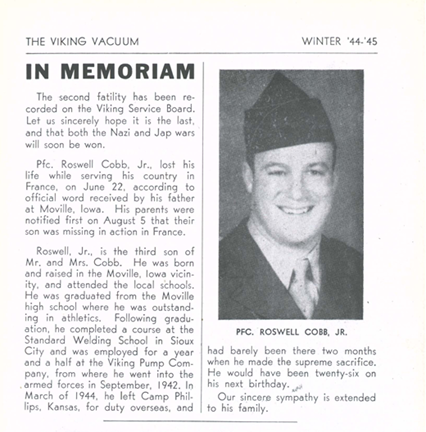
Private First Class Roswell Cobb, Jr. had worked at Viking Pump for a year and a half before entering service in September 1942. He was reported missing in action in France on June 22, 1944. His parents were notified on August 5 that he was missing; he was later confirmed dead. He would have been twenty-six on his next birthday.
Staff Sergeant Joe R. Ritchey went to work at Viking Pump immediately after graduating the Campus School and remained there until he enlisted in the air corps three years before his death. He was based in England for about two years. On January 23, 1945, he was killed trying to extinguish a fire from a bomber crash. He was buried back home in Cedar Falls.
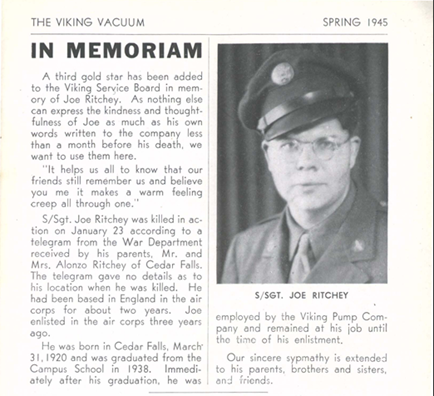
Rather than summarize his character, the editors of the Spring 1945 Viking Vacuum chose to let Joe speak for himself. In a letter he had written to the company less than a month before his death, he wrote: “It helps us all to know that our friends still remember us and believe you me it makes a warm feeling creep all through one.”
Pumps on the Front Lines
While its people served abroad, Viking Pump’s products were showing up across every theater of the war.
Fuel pumps went into Higgins FP-170 boats — the freight and personnel landing craft central to Allied amphibious operations. Diesel pumps were installed aboard transport ships like the W.S. Benson. Lube oil pumps were fitted in glider-landed tanks. And coolant pumps were shipped to Russia as part of the Allied war effort.
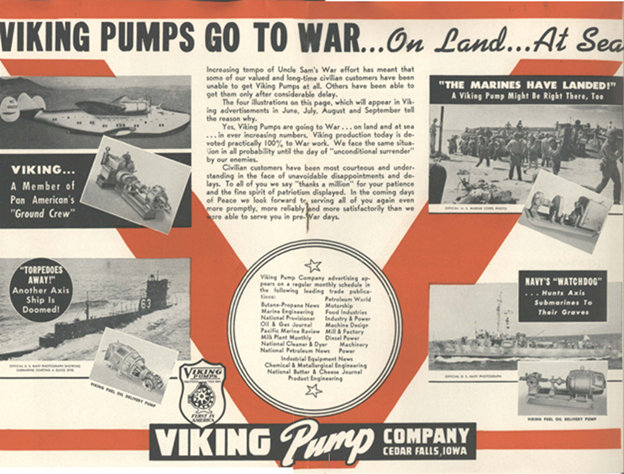
Beyond direct military hardware, Viking pumps supported critical wartime production. They were used in the manufacture of pharmaceuticals to fight malaria — a major killer of Allied troops in the Pacific — and in the production of penicillin, which was scaling from a laboratory curiosity to a battlefield necessity during the war years.
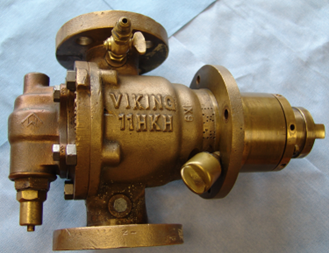
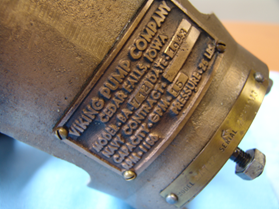
Viking pumps also served beneath the oceans’ surface. Gato-class submarines were fitted with Viking diesel pumps. One of those boats — the USS Cobia — is still on display at the Maritime Museum in Manitowoc, Wisconsin, with its original bronze Viking pumps intact and in running condition.
Letters Home
Not every wartime story was a heavy one. The Viking Vacuum regularly published excerpts from letters sent home by servicemen, and a recurring theme was the surprise of encountering Viking pumps in the field. The Winter 1943 issue ran several of these under the heading “Service Men Discover Viking Pumps”:
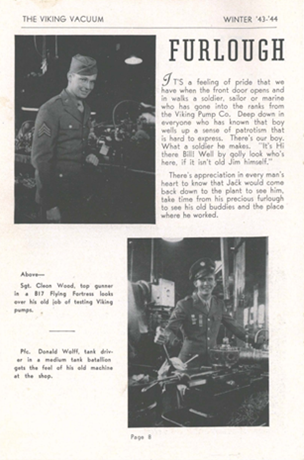
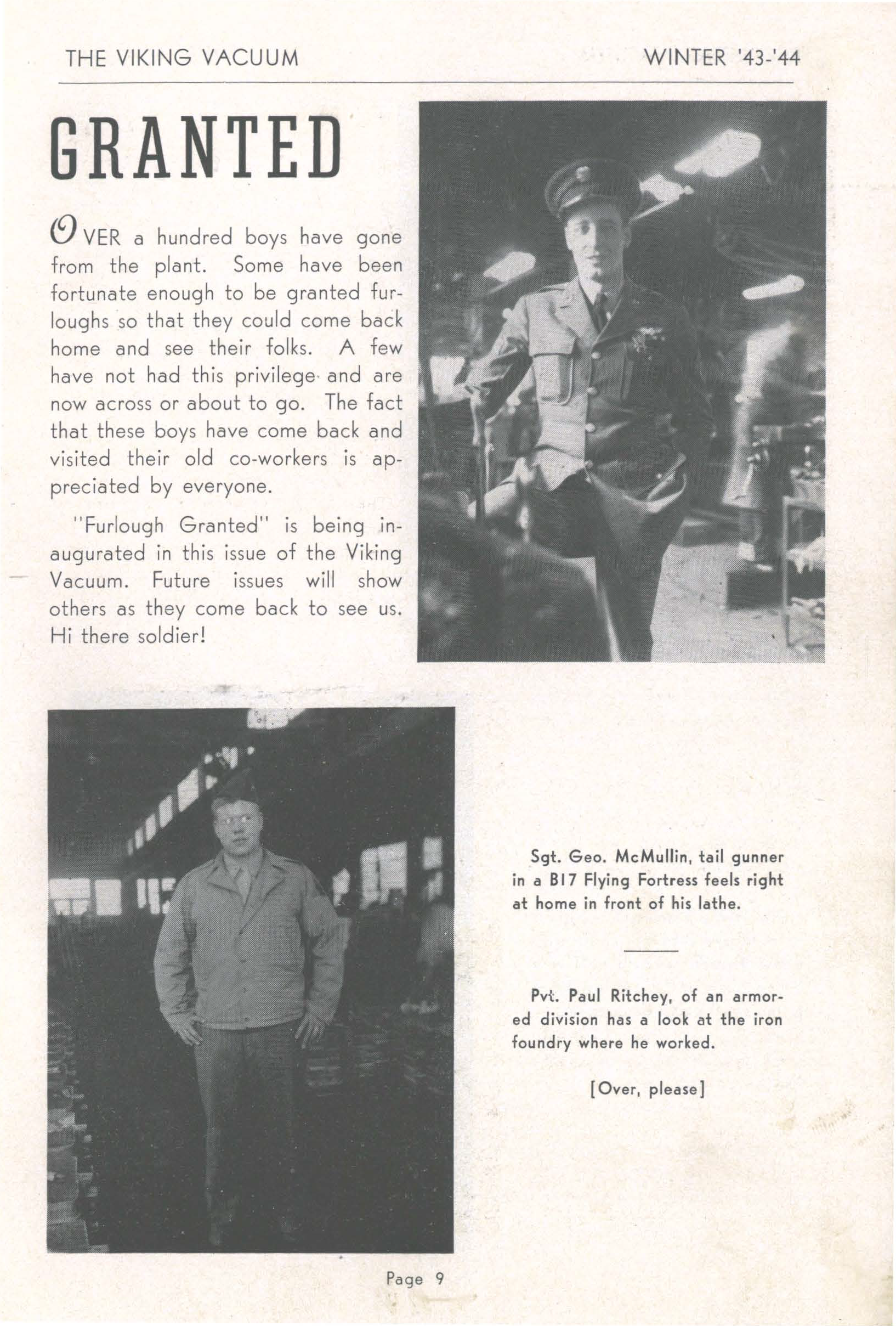
Roger Johnson, brother of Vernon Johnson in the shipping room, wrote home from the southwest Pacific: “I’ve been using one of those powerful pumps the old man made” — “the old man” being Jens Nielsen, inventor of the Viking pump, as a newsletter editor’s note explained. Richard Goranson, stationed near Africa, wrote to his aunt: “A lot of our equipment and supplies have their origin or beginning in Iowa. We have four pumps in the engine room from the Viking Pump Company.” And Donald Wolff, stationed at Camp Polk, Louisiana, wrote to his father Al about passing a refinery in Lake Charles and spotting Viking pumps in the lot. “Seemed good to see them again,” he wrote. “I told the fellows I used to help make them.”
Coming Home
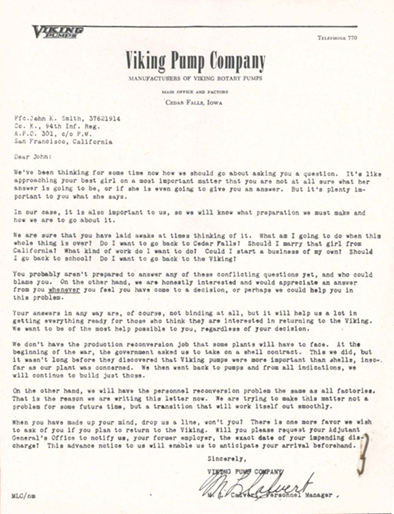
As the war wound down in the summer of 1945, Viking Pump began the work of bringing its people back. The Summer 1945 Viking Vacuum includes a letter from M.L. Calvert, the company’s personnel manager, addressed to Pfc. John K. Smith — apparently a template sent to servicemen encouraging them to consider returning to Cedar Falls and to Viking Pump.
By the next issue, the Viking Vacuum’s “Service Members” list was renamed “Veterans at Viking” as men returned to the plant floor. Some names dropped off as employees moved on to other jobs and other lives.
Remembering
Our historic newsletters captured something that a museum plaque can’t: the texture of wartime life at a small-city manufacturer. The pride when a serviceman spotted a Viking pump in an engine room half a world away. The quiet dread of a growing list of names.
Harold Ward, Roswell Cobb Jr., and Joe Ritchey were not generals or admirals. They were machinists, welders, and factory workers from Iowa who left their jobs to serve and did not come back. This Memorial Day, we remember them — and the more than 100 Viking Pump employees who answered the call alongside them.
For over a century, Viking Pump has been the global leader in positive displacement pumping solutions, trusted by industries worldwide for their expertise, innovation, and reliability. With deep knowledge across a wide range of applications—from chemicals and coatings to food and fuel—Viking Pump delivers engineered solutions that keep processes flowing smoothly.